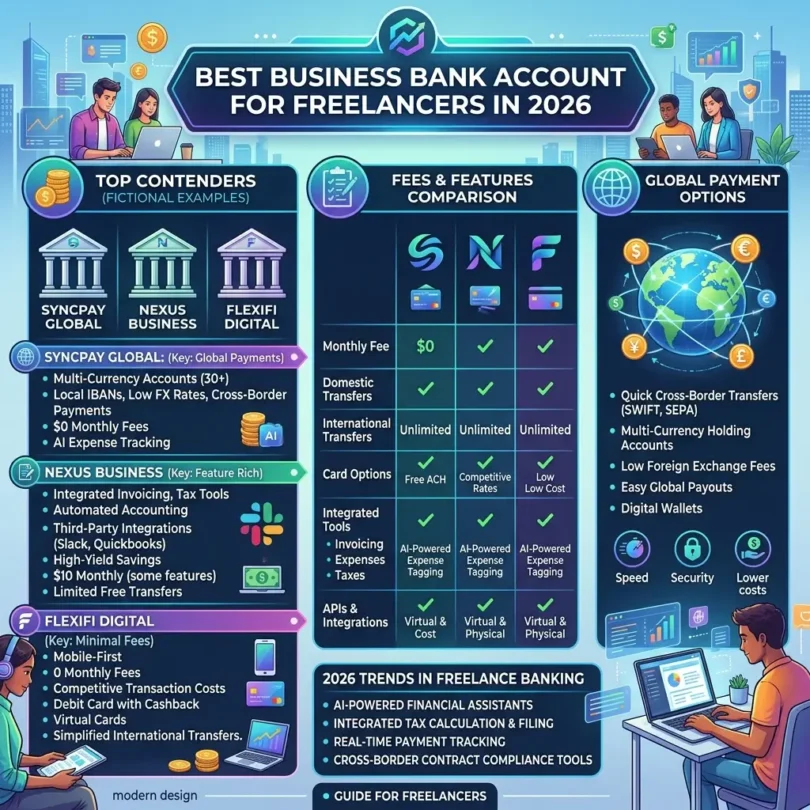

Introduction
Choosing the best business bank account for freelancers in 2026 is no longer just about finding a place to receive money. Freelancers today work with international clients, accept payments through multiple platforms, pay contractors, manage subscriptions, track taxes, send invoices, and often receive income in different currencies.
A personal bank account may seem enough when you are just starting out. But once your freelance income becomes regular, mixing personal and business money can create accounting problems, tax confusion, and cash flow issues. A dedicated business bank account helps you look more professional, separate income from expenses, and understand exactly how much your freelance work is earning.
The right account can also reduce fees. This matters because many freelancers lose money through hidden charges, poor exchange rates, incoming wire fees, card payment fees, and international withdrawal costs. A freelancer working with overseas clients needs more than a basic checking account. They need a banking setup that supports digital payments, low-cost transfers, invoicing, currency conversion, and easy reporting.
This guide explains how to choose the best business bank account for freelancers in 2026, what fees to compare, which features matter most, and how to build a smart banking system for local and international payments.
What Is a Business Bank Account for Freelancers?
A business bank account is an account used specifically for business income and expenses. For freelancers, this usually means a business checking account, online business account, multi-currency account, or fintech payment account used to receive client payments and manage freelance cash flow.
A freelancer may use a business bank account to:
- Receive payments from clients
- Pay for business software and tools
- Transfer money to contractors or suppliers
- Separate business income from personal spending
- Track tax-deductible expenses
- Receive international payments
- Connect with invoicing or accounting software
- Hold balances in different currencies
For example, a freelance designer in Pakistan may receive payments from a US client, pay for Adobe software, transfer money to a local bank, and keep part of the income in USD. A freelance developer in the UK may invoice clients in EUR, GBP, and USD. A content writer in the Philippines may use Payoneer, Wise, or a local business bank account depending on the client’s payment method.
The best business bank account depends on where you live, where your clients are located, which currencies you use, and how often you receive international payments.
Why Freelancers Need a Separate Business Bank Account
A separate business account is one of the simplest ways to make freelance work more professional. Even if you are a solo freelancer, your finances become easier to manage when business income does not mix with groceries, rent, family transfers, and personal shopping.
The biggest benefit is clean recordkeeping. When all client payments go into one account and all business expenses go out of the same account, it becomes easier to calculate profit. You can quickly see how much you earned, what you spent, and how much you should save for taxes.
The second benefit is credibility. Many clients, especially companies, prefer paying into an account that matches a business name or professional profile. A proper business account also helps when applying for payment gateways, merchant accounts, business credit cards, or accounting tools.
The third benefit is fee control. Freelancers who receive international payments through random methods often pay more than they realize. A client may send a wire transfer, the bank may charge an incoming fee, another intermediary bank may deduct money, and the exchange rate may include a markup. Over time, these charges reduce your real income.
The FDIC advises business owners to compare account costs such as transaction fees, minimum balance fees, early termination fees, and interest rates before opening business checking or savings accounts. (FDIC Information and Support Center) That advice applies strongly to freelancers because even small monthly fees can matter when income is irregular.
Best Business Bank Account Features for Freelancers in 2026
The best freelance business bank account should match the way you actually get paid. A local freelancer who only works with domestic clients may need a simple business checking account. An international freelancer may need a multi-currency account, low FX fees, and local receiving details.
Here are the most important features to compare.
1. Low Monthly Fees
Monthly maintenance fees can reduce your profit, especially when freelance income changes from month to month. Some traditional banks charge monthly fees unless you maintain a minimum balance. Online banks and fintech accounts may offer lower monthly fees, but you should still check charges for transfers, ATM withdrawals, card payments, and currency conversion.
A good freelance account should either have no monthly fee or a fee that is easy to justify because of useful features like invoicing, sub-accounts, interest, integrations, or payment tools.
Before opening an account, check:
- Monthly service fee
- Minimum balance requirement
- Account opening fee
- Dormancy or inactivity fee
- Wire transfer fee
- ATM withdrawal fee
- Card replacement fee
- Currency conversion fee
- Incoming payment fee
A free account is not always the cheapest account. Some accounts advertise no monthly fee but charge more for international payments, foreign exchange, withdrawals, or card transactions.
2. Easy Online Account Opening
Freelancers usually want a bank account that can be opened online without unnecessary paperwork. In 2026, many digital banks and fintech platforms offer remote onboarding, identity verification, and online document upload.
However, the required documents depend on your country, business structure, and account provider. A sole proprietor may need personal ID, tax information, proof of address, and business details. A registered LLC or company may need registration documents, ownership information, and tax identification.
For freelancers, common documents include:
- Government-issued ID
- Proof of address
- Tax identification number
- Business registration certificate, if applicable
- Freelance platform profile or website
- Client contract or invoice sample
- Bank statement or source-of-income proof
If you are not registered as a company, look for accounts that support sole proprietors or self-employed professionals. Some platforms are built specifically for freelancers, creators, consultants, and online businesses.
3. International Payment Support
International payment support is one of the most important features for freelancers. Many freelancers work with clients in the US, UK, EU, Canada, Australia, and the Middle East while living somewhere else. If your bank account does not support affordable international payments, your income can shrink because of transfer fees and exchange-rate markups.
A strong international business account should help you:
- Receive payments from foreign clients
- Hold money in major currencies
- Convert currency at transparent rates
- Withdraw to your local bank
- Send payments to contractors
- Receive money using local account details where available
- Avoid unnecessary wire transfer costs
Wise Business, for example, promotes its account as a way for businesses to get paid and manage expenses in different currencies, and says users can hold money in their account for free while conversion fees vary by currency. (Wise) Wise also states that its business account supports payments, receiving money, spending, and managing expenses in different currencies. (Wise)
Payoneer is another popular option among international freelancers. Payoneer says its local receiving accounts allow businesses to receive payments as if they had local account details and transfer funds between currencies such as USD, GBP, EUR, and more. (Payoneer) Payoneer’s 2026 pricing information also notes that some business transfers received through direct account details can cost up to 1%, while Payoneer-to-Payoneer transfers are generally free and card-based client payments may carry higher fees. (Payoneer)
The key lesson is simple: do not choose a business account only because it is popular. Choose it based on your client locations, currencies, and withdrawal method.
4. Local Receiving Details
Local receiving details can be extremely useful for freelancers. Instead of asking a US client to send an international wire transfer, you may be able to provide USD receiving details. Instead of asking a European client to pay through an expensive transfer, you may be able to provide EUR details.
This can make payment easier for the client and cheaper for you. It also makes your freelance business look more professional because clients can pay using familiar local rails.
Local receiving details may include:
- USD account details
- EUR IBAN
- GBP account details
- AUD account details
- CAD account details
- JPY account details
Not every provider supports every country or every currency. Some accounts are available only in specific regions. Always check availability before building your payment workflow around one provider.
5. Multi-Currency Balance
A multi-currency account lets you hold funds in more than one currency. This is helpful if you earn in USD but do not want to convert everything immediately. It can also help if you pay for tools, contractors, or subscriptions in the same currency.
For example, if you receive USD from clients and pay for software in USD, keeping part of your balance in USD may reduce repeated conversion costs. If you receive EUR and later travel or pay expenses in EUR, holding EUR may also be useful.
A multi-currency business account is especially valuable for:
- Freelancers with international clients
- Remote agencies
- Digital marketers
- Software developers
- Consultants
- Virtual assistants
- Ecommerce service providers
- Creators selling globally
But multi-currency accounts are not always full bank accounts. Some fintech providers are regulated payment institutions or money service businesses rather than banks. That does not automatically make them unsafe, but it means you should understand how your funds are protected, what regulations apply, and whether deposit insurance is available.
6. Deposit Protection and Account Safety
Safety matters as much as convenience. If you are using a bank, check whether deposits are protected by a recognized deposit insurance scheme. In the US, the FDIC explains that deposits owned by a corporation, partnership, or unincorporated entity at the same insured bank are added together and insured up to $250,000, separately from the personal accounts of owners or members. (FDIC)
For freelancers outside the US, deposit protection rules vary by country. In some cases, fintech accounts are not insured the same way traditional bank deposits are. Some providers safeguard customer funds under payment institution rules instead of offering bank deposit insurance.
Before choosing an account, check:
- Is the provider a bank, fintech, payment institution, or money services business?
- Is your money covered by deposit insurance?
- Which country regulates the provider?
- Are business balances protected differently from personal balances?
- What happens if the provider fails?
- Does the account use partner banks?
Do not keep all your freelance money in one place without understanding risk. Many experienced freelancers use a combination of accounts: one for receiving international payments, one local bank account for savings and withdrawals, and one tax reserve account.
7. Invoicing and Payment Links
Freelancers need to get paid on time. A business bank account that connects with invoicing tools can save time and reduce missed payments.
Some online business accounts offer built-in invoicing. Others integrate with accounting software, payment gateways, or bookkeeping apps. The best setup allows you to send an invoice, let the client pay by bank transfer or card, and automatically track the payment.
Useful invoicing features include:
- Professional invoice templates
- Payment links
- Recurring invoices
- Automatic reminders
- Partial payments
- Client records
- Tax fields
- Currency selection
- Invoice status tracking
Payment links can increase convenience, but they may involve card processing fees. Bank transfers may be cheaper but slower or less convenient depending on the country. A smart freelancer offers payment options while clearly explaining who pays the fees.
8. Accounting and Tax Tracking
A business bank account should make taxes easier, not harder. Even if you use a simple spreadsheet, a separate business account gives you cleaner data.
Look for features such as:
- CSV export
- Accounting software integration
- Expense categories
- Receipt upload
- Sub-accounts or envelopes
- Tax savings buckets
- Monthly statements
- Searchable transactions
Freelancers should also separate income from tax reserves. For example, you can move a fixed percentage of every payment into a tax savings account. This reduces stress when tax deadlines arrive.
A good banking system helps answer important questions:
- How much did I earn this month?
- Which clients paid me?
- Which invoices are unpaid?
- How much did I spend on software?
- How much should I save for taxes?
- Which payments were business expenses?
- How much profit did I actually keep?
9. Business Debit Card and Expense Control
A business debit card helps freelancers pay for business expenses without mixing personal spending. You can use it for software subscriptions, domain renewals, hosting, ads, coworking spaces, travel, and client-related purchases.
The best accounts offer:
Virtual cards are especially useful for online subscriptions. You can create a card for specific software or marketing tools, then freeze it if needed.
- Virtual cards
- Physical debit cards
- Spending limits
- Card freeze/unfreeze
- Separate cards for team members
- Instant transaction alerts
- Expense notes
- Foreign transaction transparency
10. ATM Access and Local Withdrawals
If you regularly withdraw cash, check ATM fees carefully. Some online accounts are excellent for digital payments but expensive for cash withdrawals. Others may not support local cash deposits or cash withdrawals in your country.
For most online freelancers, ATM access is less important than transfer fees and currency conversion. But if you travel often or live in a cash-heavy economy, ATM fees can add up.
Compare:
- ATM withdrawal fee
- Foreign ATM fee
- ATM network access
- Daily withdrawal limit
- Currency conversion markup
- Local bank withdrawal cost
- Cash deposit availability
Best Types of Business Bank Accounts for Freelancers
There is no single best account for every freelancer. Instead, choose the right type of account based on your work model.
Traditional Business Checking Account
A traditional business checking account is useful if you operate locally, need bank branch access, accept checks, deposit cash, or want a relationship with a bank. It may also help when applying for business loans, business credit cards, or merchant services.
Pros:
- Strong local banking support
- Possible deposit insurance
- Branch access
- Business checks
- Cash deposits
- Better for registered businesses
Cons:
- Monthly fees may apply
- International transfers can be expensive
- Slower onboarding
- More paperwork
- Poor exchange rates in some cases
Best for: local freelancers, consultants, agencies, and registered small businesses that need traditional banking support.
Online Business Bank Account
An online business bank account is usually faster, cheaper, and easier to manage. Many online banks offer low fees, digital cards, expense tracking, and integrations.
Pros:
- Easy online access
- Lower fees
- Fast setup
- Good app experience
- Expense tools
- Useful for remote work
Cons:
- Limited cash deposits
- No physical branch
- May have account eligibility restrictions
- International payments vary by provider
Best for: digital freelancers, creators, consultants, developers, marketers, and remote service providers.
Multi-Currency Business Account
A multi-currency account is designed for freelancers who earn from international clients. It helps you receive, hold, convert, and send money in different currencies.
Pros:
- Useful for global clients
- Can reduce FX costs
- Local receiving details may be available
- Good for USD, EUR, GBP payments
- Helpful for international contractors
Cons:
- Not always a bank account
- Deposit insurance may differ
- Some withdrawals or conversions have fees
- Availability depends on country
Best for: international freelancers, remote agencies, marketplace sellers, and cross-border service providers.
Payment Platform Account
Some freelancers receive money through platforms such as Payoneer, Stripe, PayPal, or marketplace payment systems. These accounts can be useful, but they should not always replace a proper business bank account.
Pros:
- Easy client payments
- Popular with platforms
- Card and online payment options
- International reach
- Fast onboarding
Cons:
- Fees can be higher
- Account holds may happen
- Withdrawal charges may apply
- Exchange rates may include markup
- Not always ideal for storing large balances
Best for: freelancers who work through marketplaces, ecommerce platforms, or clients who prefer card payments.
How to Choose the Best Business Bank Account for Freelancers
Use this step-by-step framework before opening an account.
Step 1: Identify Where Your Clients Are Located
Your client location determines your payment needs. A freelancer with only local clients may not need Wise or Payoneer. A freelancer with US, UK, and EU clients may benefit from USD, GBP, and EUR receiving options.
Ask yourself:
- Are my clients local or international?
- Which countries pay me most often?
- Which currencies do I invoice in?
- Do clients prefer bank transfer, card, PayPal, Wise, or Payoneer?
- Do I need local account details?
Step 2: Calculate Your Real Payment Cost
Do not compare accounts only by monthly fee. Compare the full cost of receiving, converting, withdrawing, and spending money.
For each account, calculate:
- Incoming payment fee
- Currency conversion fee
- Exchange rate markup
- Withdrawal fee
- Monthly fee
- Card fee
- Wire fee
- Payment gateway fee
Example: If you receive $2,000 from a US client and lose $60 through conversion and transfer charges, your real fee is 3%. That may be more expensive than an account with a small monthly fee but lower FX costs.
Step 3: Check Account Eligibility
Not every freelancer can open every account. Some providers support only certain countries, business types, or documents. Before writing your business workflow around an account, confirm that you can actually open it.
Check:
- Supported countries
- Accepted business types
- Required documents
- Verification time
- Restricted industries
- Minimum balance
- Tax requirements
Step 4: Look for Tax and Accounting Features
Your bank account should help you stay organized. If an account does not export statements or connect with accounting tools, it may create extra work later.
Useful features include:
- Downloadable statements
- CSV export
- Invoice matching
- Accounting integrations
- Expense categories
- Receipt notes
- Sub-accounts
Step 5: Build a Two-Account or Three-Account System
Many freelancers should not rely on only one account. A better structure may look like this:
Account 1: International receiving account
Used for USD, EUR, GBP, or global client payments.
Account 2: Local business bank account
Used for local withdrawals, savings, bills, and tax payments.
Account 3: Tax reserve or savings account
Used to separate tax money and emergency funds.
This setup gives you flexibility. If one provider has a delay, you still have access to another account. If exchange rates are poor one week, you can wait before converting. If you need local proof of income, your local bank statements are organized.
Common Business Bank Account Fees Freelancers Should Avoid
Freelancers should pay close attention to hidden fees. Some fees are obvious, while others are buried in exchange rates or payment method rules.
Watch for:
- Monthly maintenance fees
- Minimum balance fees
- Incoming wire fees
- Outgoing wire fees
- International transfer fees
- Currency conversion markup
- ATM withdrawal fees
- Foreign transaction fees
- Card payment processing fees
- Account inactivity fees
- Platform withdrawal fees
- Intermediary bank deductions
A bank may advertise “free transfers” but offer a poor exchange rate. Another provider may show a low conversion fee but charge for withdrawals. Always compare the amount you actually receive in your local bank account.
Best Business Bank Account Setup for International Freelancers
For international freelancers, the best setup usually includes three layers.
First, use a global receiving account for clients. This may be Wise Business, Payoneer, or another regulated payment platform depending on your country and client needs.
Second, use a local bank account for your home country. This helps you pay local bills, taxes, and personal expenses after transferring your business income.
Third, use bookkeeping software or a spreadsheet to track invoices, expenses, taxes, and profit.
A practical workflow may look like this:
- Send invoice in USD
- Client pays to USD receiving details
- Funds arrive in international business account
- You hold USD until conversion is needed
- You convert at a transparent rate
- You withdraw to your local business bank account
- You move tax percentage to savings
- You record invoice and expense details
This system is simple, professional, and scalable.
Mistakes Freelancers Make When Choosing a Business Bank Account
The biggest mistake is choosing an account only because another freelancer recommended it. Banking depends on location, currency, client type, and business structure. What works for a US-based consultant may not work for a freelancer in Pakistan, India, Nigeria, the Philippines, or the UAE.
Another mistake is ignoring exchange rates. Freelancers often focus on transfer fees but forget that exchange-rate markups can be more expensive than visible fees.
A third mistake is keeping all money inside a payment platform. Payment platforms are useful for receiving money, but they may not be ideal for long-term savings. Withdraw profits regularly and keep emergency funds in a safe account.
A fourth mistake is mixing personal and business transactions. This makes tax reporting harder and creates confusion when reviewing profit.
A fifth mistake is not reading the fee page. Fee schedules change. Always check the latest pricing before opening or recommending an account.
Final Verdict: What Is the Best Business Bank Account for Freelancers in 2026?
The best business bank account for freelancers in 2026 is the one that matches your payment reality.
If you work with local clients, a low-fee business checking account from a trusted local bank may be enough. If you work with international clients, look for a multi-currency business account with transparent conversion fees, local receiving details, and easy withdrawals. If you accept card payments, compare payment gateway fees carefully. If you want better bookkeeping, choose an account that connects with invoicing and accounting tools.
For most freelancers, the smartest setup is not one account. It is a combination of accounts: one for receiving global payments, one for local banking, and one for tax savings.
Before opening an account, compare the full cost of receiving money, converting currency, withdrawing funds, and maintaining the account. Also check safety, regulation, deposit protection, customer support, and country availability.
A good freelance banking setup helps you get paid faster, reduce fees, manage taxes, and look more professional. In 2026, that is not just convenient—it is a competitive advantage.
FAQs
Do freelancers need a business bank account?
Freelancers do not always legally need a business bank account, but it is strongly recommended. A separate account helps you track income, manage expenses, prepare taxes, and present a more professional image to clients.
Can I use my personal bank account for freelance payments?
You can in some cases, especially when starting out, but it can create problems later. Mixing personal and business transactions makes bookkeeping harder and may look less professional when dealing with companies or payment platforms.
What is the best bank account for international freelancers?
The best account depends on your country and client currencies. International freelancers should compare multi-currency support, local receiving details, withdrawal fees, currency conversion costs, and account safety.
Is Wise Business good for freelancers?
Wise Business can be useful for freelancers who work with international clients and need multi-currency features. Wise says businesses can manage money in different currencies, and its pricing page lists free balance holding with currency conversion fees varying by currency. (Wise)
Is Payoneer good for freelancers?
Payoneer can be useful for freelancers who receive payments from marketplaces, international clients, or companies that prefer local receiving details. Payoneer says its local receiving accounts help businesses get paid like a local in supported currencies and regions. (Payoneer)
What fees should freelancers check before opening a business account?
Freelancers should check monthly fees, minimum balance fees, incoming transfer fees, outgoing transfer fees, currency conversion fees, ATM fees, card fees, and withdrawal fees.
Should I keep money in a payment platform?
Payment platforms are useful for receiving money, but freelancers should avoid keeping all funds in one place. It is usually safer to withdraw regularly to a trusted bank account and keep separate reserves for taxes and emergencies.